Nāda (नाद) is Sanskrit for "sound": in Indian music theory, the primordial sound every note comes from.
nāda is a music player for people who live on the keyboard. Songs on your disk and music from YouTube share one queue. Play a song and, like YouTube, nāda lines up what comes next; reorder or remove anything with vim keys. Lyrics scroll along with the song. If you like a YouTube song, D saves it to your music folder, with its tags, cover and lyrics, while it keeps playing. It runs on MPD, so your library, queue and playback carry on with the window closed. Its phone side, nāda for Android, brings the same music to your pocket.
#Download
nāda for the desktop
The keyboard-driven player: your files and YouTube in one queue, synced lyrics, a floating mini player. Install it with git in two lines.
Install on Linux →
nāda for your phone
YouTube Music with no account, history and a feed that learn you on the phone, home-screen widgets. The APK will be on the Releases page.
Download the APK →
#Features
- Search everything from one key.
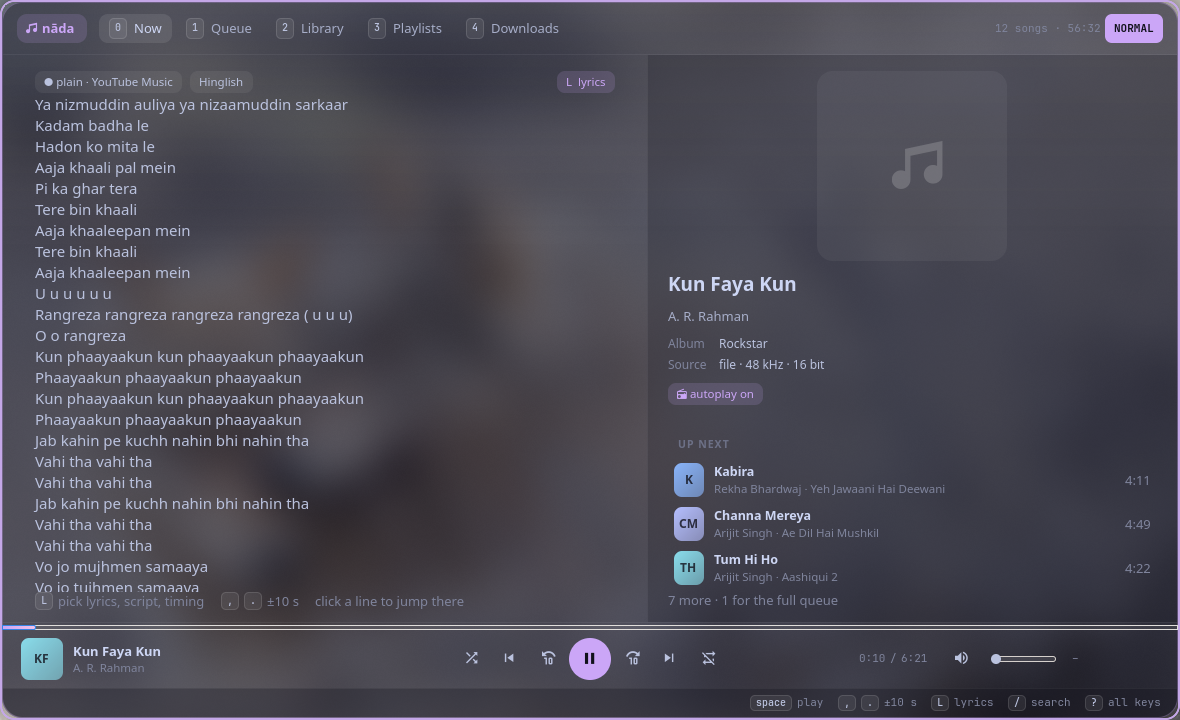
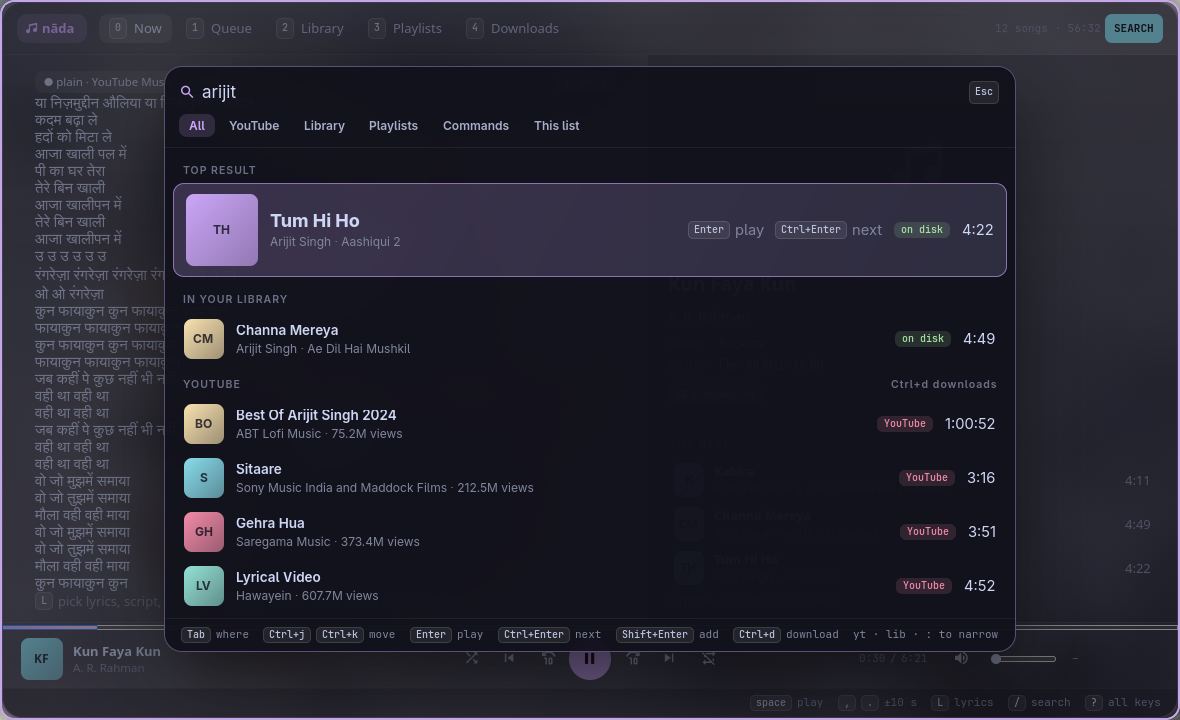
/opens a floating search over whatever you're on: your library answers as you type, YouTube a moment later, with the best match on top;Tabpicks where to look (YouTube, library, playlists, commands, the list you're on). Play, play next, add or download without leaving the box. - Now is the lyrics. The window opens on the playing song's lyrics, large, the current line lit and centred, scrolling with the song. Click a line to jump there. On the right: the cover, the song's real name and artists (from YouTube Music, not the upload's title), the album, views, and what's next.
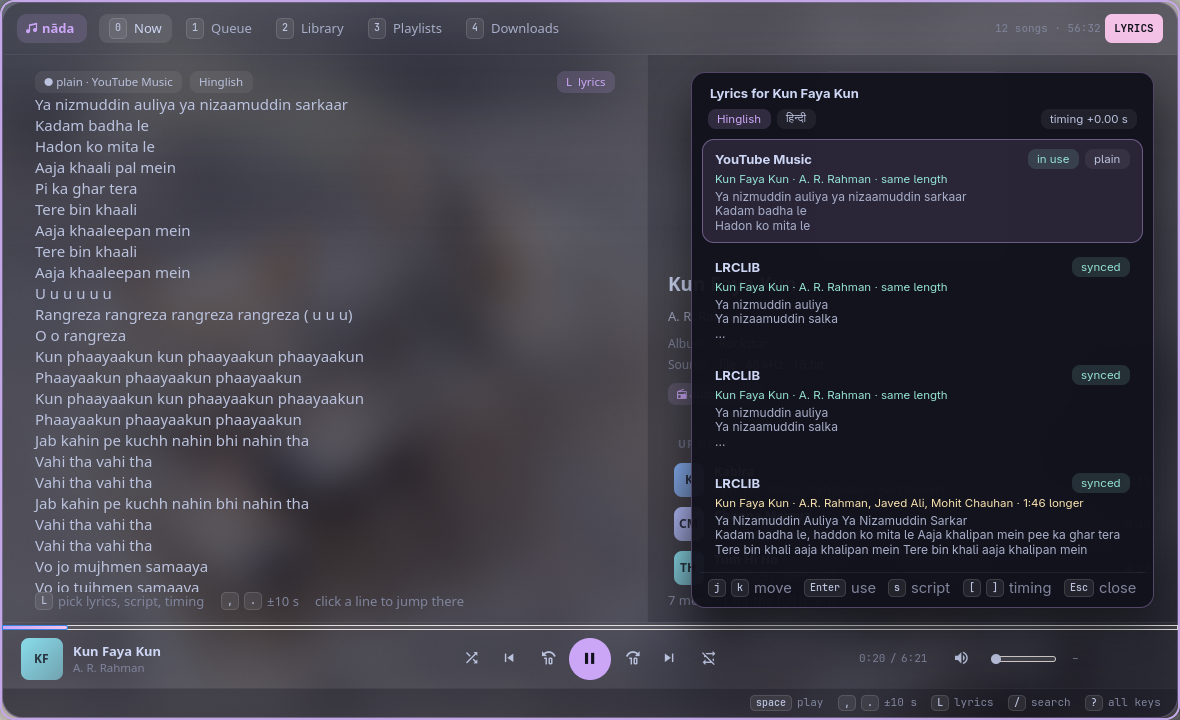
- Lyrics that show up. Looked up in YouTube Music first (by the video itself: synced lyrics licensed from LyricFind), then LRCLIB and NetEase; a
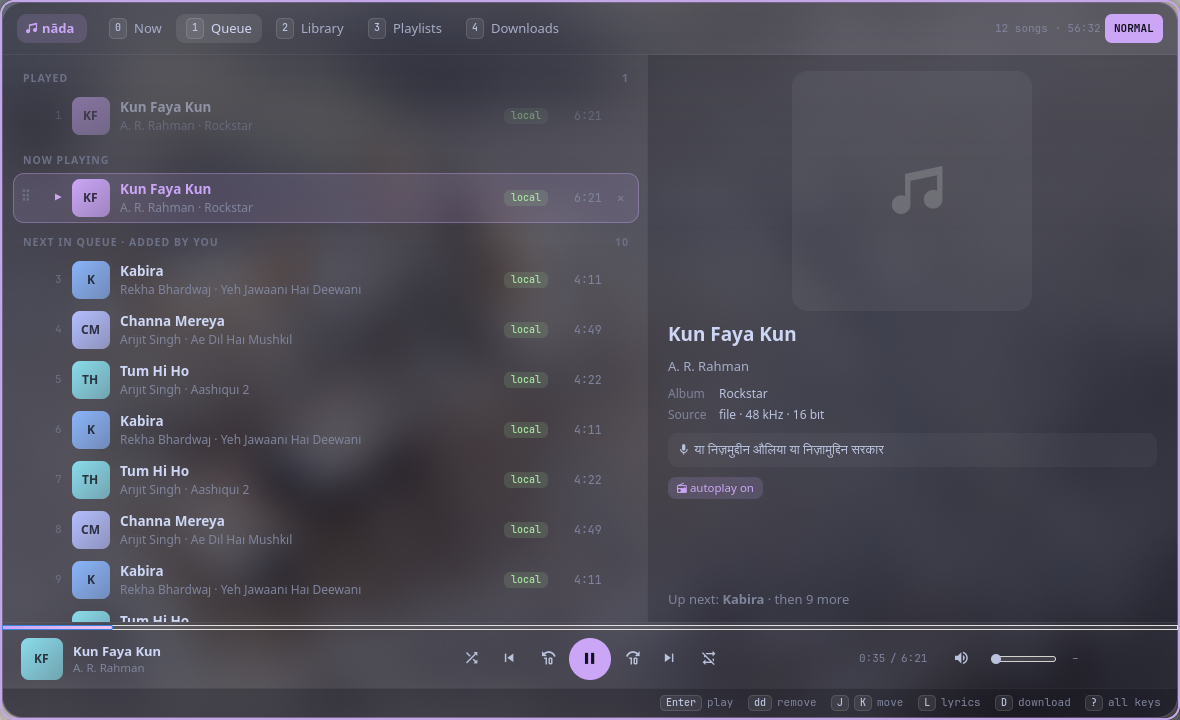
.lrcnext to the file or lyrics in its tags come first. A source that can't be reached is asked again in 30 s, never remembered as "no lyrics". Hindi lyrics show in Latin letters (Hinglish) or Devanagari.Lopens the lyrics panel: every version the sources have, which one fits the song's length,[]to fix the timing,sfor the script. - Up next, like YouTube. Playing a YouTube song lines up YouTube's own mix for it; a song from your library brings the rest of its album and more by that artist. The queue shows what you added and what autoplay added separately, refills itself as it runs low, and
Mturns it off. - Your queue, edited like text.
ddremoves,J/Kmove a song,yy/pcopy and paste,Vselects several,uundoes,Ctrl+rredoes, and you can drag rows by their handle or click × to remove one. - Seek anywhere.
,and.skip 10 seconds (3.skips 30), the ⟲ ⟳ buttons do the same, and the progress bar is clickable. - YouTube without an account. Search it from
/; every result shows its views and age, and "All YouTube results" opens the full list. Stream links expire after a few hours, so nāda remembers the video, not the link, and renews it before it plays. - Download what you like.
Dsaves a YouTube song as Opus (what YouTube streams, so nothing is re-encoded) into~/Music/YouTube/<Artist>/<Title>.opus, with tags, cover art and a.lrclyrics file. When it finishes, the queue entry is swapped for the file in place, and playback carries on from the same second. - Your library in columns, like yazi: artists, albums, genres or folders (
Tab),h/lbetween columns,/searches everything. - Playlists that mix files and YouTube songs:
:w namesaves the queue,:e nameloads one. - A mini player (
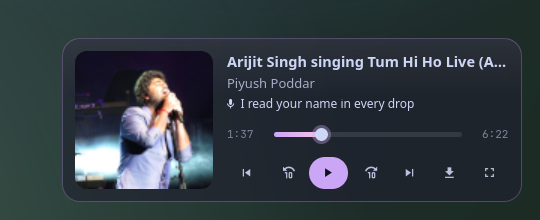
z) in the corner, with the current lyric line. - Everywhere on the desktop: MPRIS for media keys,
playerctland your phone (KDE Connect); a waybar module;nada ctlfor scripts and key bindings; a notification with the cover when the song changes. - Never freezes: anything slow (YouTube, lyrics, covers) runs in the background.
#On your phone
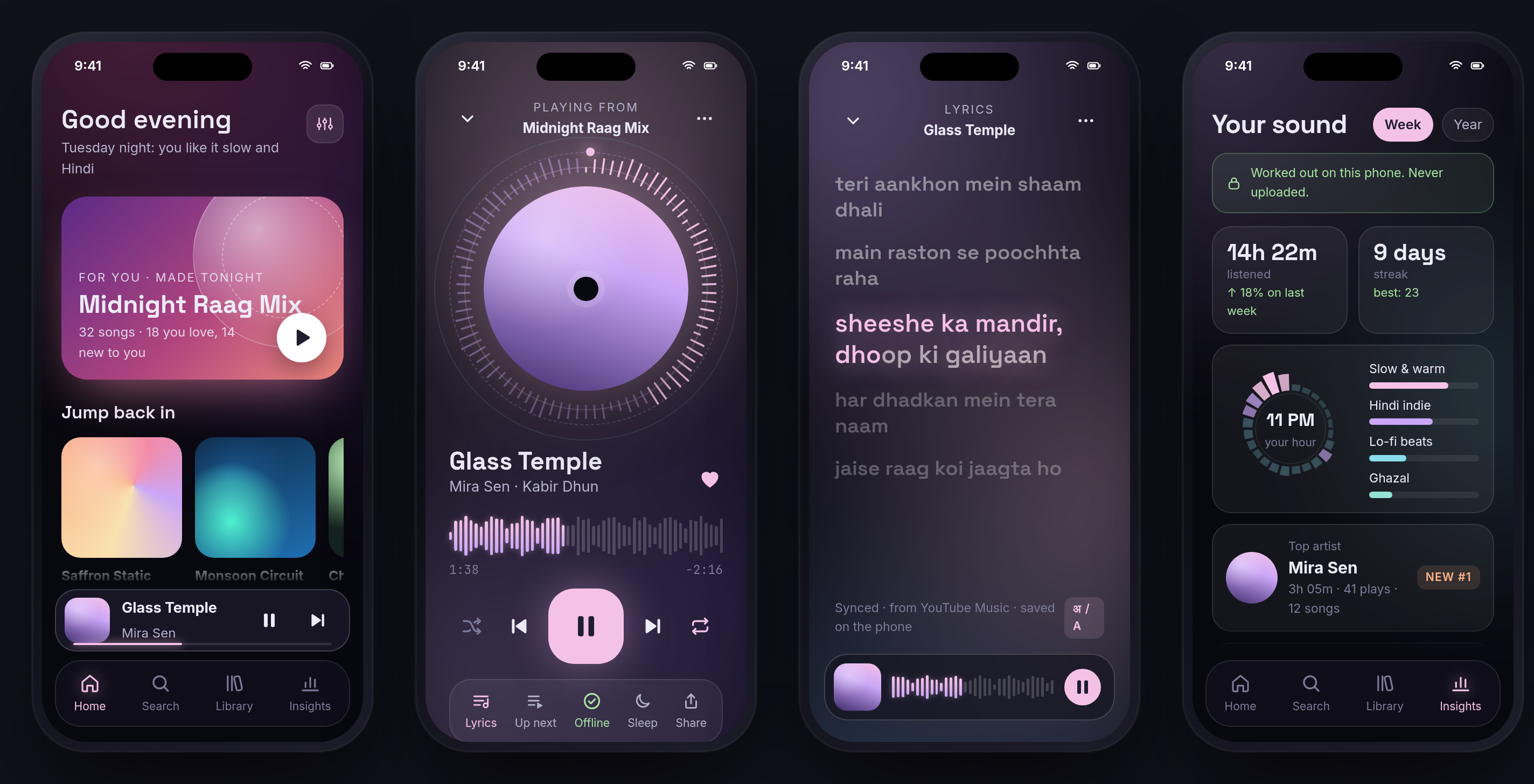
nāda for Android is the same player made for a phone: dark glass over colour taken from the cover that's playing, with pink always marking where you are. There is nothing to sign in to and no server. Songs come from YouTube Music, and everything else stays on the phone.
- A feed that learns you, on the phone. Every play is a row in a SQLite database on the phone. Finishing, replaying, liking or downloading a song counts for it, skipping it early counts against it, and older plays slowly count less. Home is built from that, mixed with YouTube Music's own "related" songs: mixes for the time of day, "More like" your most-replayed song, "Rediscover" what you loved a month ago. Each row says why it's there.
- Offline first. YouTube Music is the only thing the app talks to. Song details, covers, lyrics and related lists are kept once fetched; with no signal, Home and search use your downloads and history.
- Search that answers at once. Your history and downloads answer while you type, even in airplane mode; YouTube Music answers below.
- Lyrics, large and in time, the sung line lit, Hindi in Latin letters or Devanagari, as on the desktop.
- Insights: listening time, streaks, top artists, moods and the hours you listen at, worked out on the phone and never uploaded.
- Downloads keep their cover, lyrics and tags; Wi-Fi only by default.
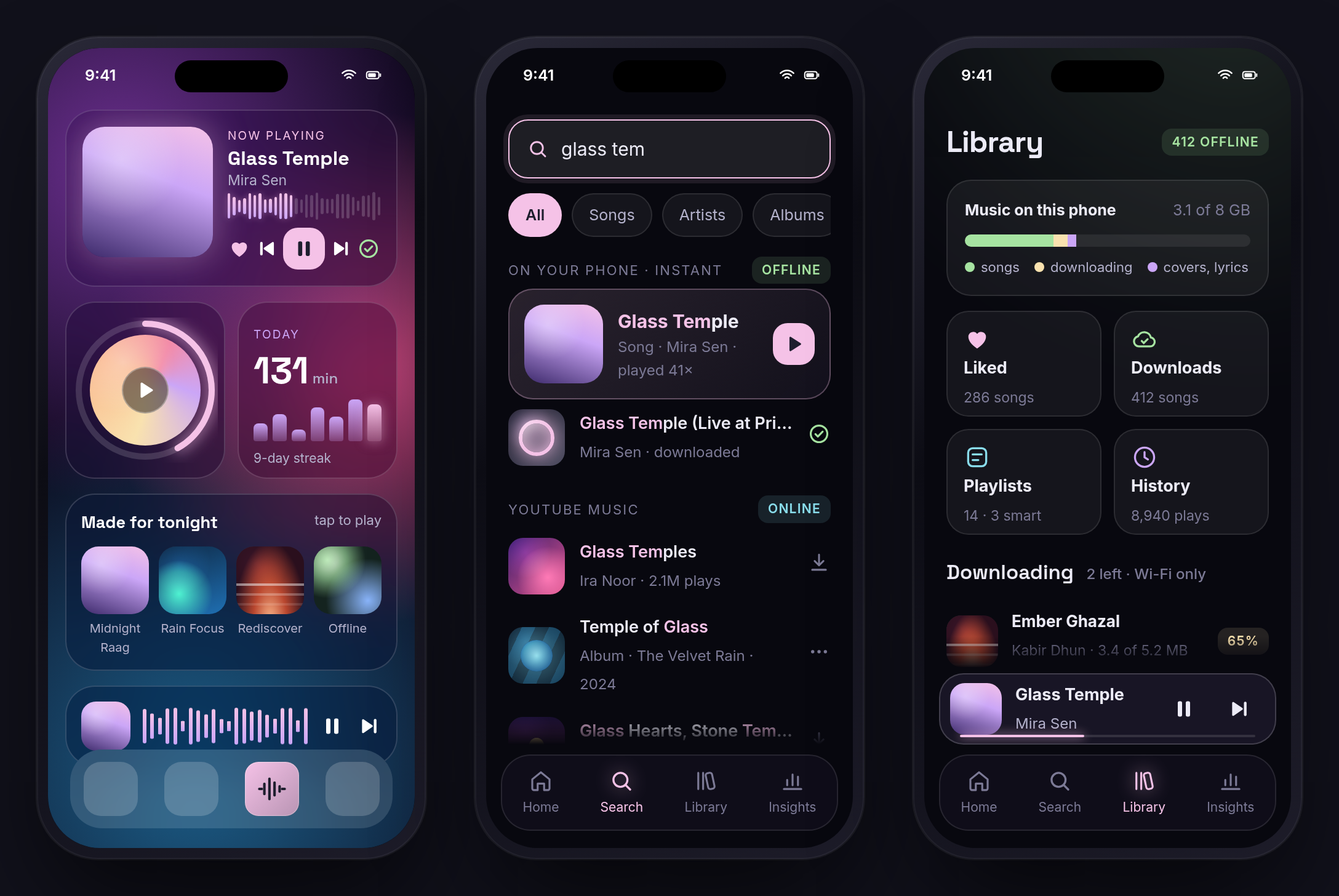
Widgets: Now playing (4×2), Orb (2×2), Today (2×2), Made for tonight (4×2) and Pulse (4×1), plus the playing song on the lock screen and the always-on display. Each plays, pauses and skips without opening the app.
The Android app is being built (Expo and React Native, with SQLite on the phone); the screens above are its design. The first APK will be on the Releases page.
#Install
#Android
Download nada.apk from the Releases page on your phone and open it (Android asks once to allow installs from your browser). It updates the same way. The first APK isn't out yet.
#Linux: what it needs
- Python 3.11+, PyGObject, GTK 4
- MPD (the engine: it plays, keeps the queue and indexes your music)
- yt-dlp for YouTube, and ffmpeg for downloads
- python-ytmusicapi for lyrics from YouTube Music and songs' real names (without it, LRCLIB and NetEase only)
- optional: gtk4-layer-shell (the mini player floats in a corner), mutagen (tags on downloads), a Nerd Font for the icons
# Arch
sudo pacman -S --needed python-gobject gtk4 mpd yt-dlp ffmpeg python-ytmusicapi python-mutagen gtk4-layer-shell ttf-jetbrains-mono-nerd
systemctl --user enable --now mpd
MPD needs a music_directory and an audio output; the Arch wiki has a five-line config. nāda finds MPD the way every MPD client does: MPD_HOST / MPD_PORT, else MPD's socket in $XDG_RUNTIME_DIR/mpd/socket, else localhost:6600.
#Linux: nāda
git clone https://github.com/Theyashsawarkar/nada ~/.local/share/nada
ln -s ~/.local/share/nada/bin/nada ~/.local/bin/nada
nada            # opens the player (it starts itself the first time)
Update with git -C ~/.local/share/nada pull && nada quit.
#Usage
nada                       open the player, or close it if it's open
nada show | hide | mini    the full player, hidden, the mini player
nada tab <name>            open on a tab: home queue library youtube playlists downloads
nada add [--next|--play] <YouTube URL | file | search words>
nada ctl toggle|play|pause|stop|next|prev
nada ctl seek +10 | seek -10 | seek 1:30
nada ctl vol +5 | vol -5 | vol 40
nada status [--json]       what's playing
nada waybar                JSON for a waybar module
nada daemon | quit         start / stop the player (MPD keeps playing)
The player is one resident process; nada only sends it a D-Bus message, so it opens at once. ctl, status and waybar talk to MPD directly and work even when the player isn't running. q and Esc only hide the window: the music, autoplay and downloads carry on. :q (or nada quit) closes nāda itself; MPD finishes what's queued.
nada is a toggle: closed, it opens; open and focused, it hides; open but behind other windows or on another workspace, it comes to you, focused.
#Keys
nāda is vim-driven, with Space as the leader, the same grammar as every Vayu tool: a key you use all the time is one key (j/k, p play/pause, H/L tabs, dd, yy); everything else is Space, then a group, then the thing (Space p s shuffle, Space t l the library). Wait a moment after Space (or g, d, y) and a strip shows what can come next; Esc cancels. Space Space opens a palette of every action, ? or Space ? shows every key of the tab you're on. Counts work like vim: 5j, 3., 2dd; digits are always counts (tabs are H/L, Space t, Ctrl+0..4). While typing, Ctrl+j/Ctrl+k move. Confirmations take y only.
Moved in this release (the old key says where, then goes away): Space play/pause is p; queue paste p/P is gp/gP; s shuffle is Space p s; r repeat is Space p r (r now refreshes); L lyrics is Space u l (L is the next tab); i info is Space i; zz is Space g p; a lone 0-4 is H/L or Space t.
Everywhere
| Key | Action |
|---|---|
j | Move down a song (counts work: 5j) |
k | Move up a song |
g g | Jump to the top (12gg: to the 12th) |
G | Jump to the bottom (12G: to the 12th) |
Ctrl+d | Scroll half a page down |
Ctrl+u | Scroll half a page up |
H | Switch to the previous tab (wraps around) |
L | Switch to the next tab (wraps around) |
Ctrl+Tab | Switch to the next tab (also from the search box) |
Ctrl+Shift+Tab | Switch to the previous tab (also from the search box) |
Ctrl+0 | Switch to Now at once (Ctrl+1 Queue, 2 Library, 3 Playlists, 4 Downloads) |
p | Toggle play / pause |
Enter | Play the selected song |
. | Seek forward 10 seconds (3. = 30 s) |
, | Seek back 10 seconds |
> | Play the next song |
< | Play the previous song |
= | Raise the volume |
- | Lower the volume |
m | Toggle mute |
M | Toggle autoplay (more like this after your songs) |
V | Select several songs (visual mode) |
u | Restore the last change (undo) |
Ctrl+r | Restore an undone change (redo) |
D | Save the playing YouTube song to your music folder (download) |
r | Refresh: rescan the music folder and reload the lists |
/ | Open the search panel (your library, YouTube, playlists, : commands, this list) |
o | Open the search panel to paste a YouTube link |
: | Run a command (:w name, :sleep 30m, :yt query…) |
? | Show every key of this tab |
z | Switch to the mini player |
q | Close the window (the music keeps playing) |
Esc | Go back, or close the window |
s | Show where shuffle moved (Space p s; for one release) |
i | Show where song info moved (Space i; for one release) |
0 | Show where the tab numbers moved (H / L, Space t; for one release) |
Space Space | Open the palette (every action of this tab, fuzzy) |
Space ? | Show every key of this tab |
Space q | Close the window (the music keeps playing) |
Space t n | Switch to Now (the lyrics) |
Space t q | Switch to the queue |
Space t l | Switch to the library |
Space t p | Switch to playlists |
Space t d | Switch to downloads |
Space u l | Toggle the lyrics on the right (Now: open the lyrics panel) |
Space u m | Switch to the mini player |
Space p s | Toggle shuffle |
Space p r | Cycle repeat (off, all, this song) |
Space p a | Toggle autoplay (more like this after your songs) |
Space p z | Toggle the sleep timer (fades out in 30 min) |
Space l l | Open the lyrics panel (pick a version, the script, the timing) |
Space l s | Switch the lyrics script: Hinglish (Latin letters) or Devanagari |
Space l [ | Show the lyrics earlier by 0.25 s (kept for the song) |
Space l ] | Show the lyrics later by 0.25 s (kept for the song) |
Space y y | Copy the playing song's title and artist |
Space y l | Copy the playing song's link (YouTube) or file path |
Space f f | Search everything |
Space f y | Search YouTube |
Space f l | Search your library |
Space f p | Search your playlists |
Space f c | Search the : commands |
Space f t | Search this list |
Space x d | Save the song to your music folder (download) |
Space i | Show the song's title, artist and link |
Space g p | Go to the song that's playing (in the queue) |
Space o b | Open the playing song on YouTube in the browser |
Space r | Refresh: rescan the music folder and reload the lists |
Space d c | Clear the queue (asks first; u brings it back) |
Queue
| Key | Action |
|---|---|
d d | Remove the song from the queue (2dd: two; u undoes it) |
x | Remove the song from the queue (like dd; u undoes it) |
d G | Remove every song from here to the end (u undoes it) |
y y | Copy the song (yank; 3yy: three) |
g p | Paste removed or copied songs below |
g P | Paste removed or copied songs above |
J | Move the song down |
K | Move the song up |
A | Move the song to play next |
D | Save the YouTube song to your music folder (download; V: the selection) |
n | Jump to the next match (after a "This list" search) |
N | Jump to the previous match |
Space d d | Remove the song from the queue (u undoes it) |
Library
| Key | Action |
|---|---|
h | Move to the column on the left |
l | Move to the column on the right |
Tab | Switch between artists, albums, genres and folders |
Enter | Play the artist, album or song (replaces the queue) |
a | Add to the end of the queue |
A | Add to play next |
Space a a | Add to the end of the queue |
Space a n | Add to play next |
YouTube results
| Key | Action |
|---|---|
Enter | Play the result |
a | Add the result to the end of the queue |
A | Add the result to play next |
D | Save the result to your music folder (download) |
Space a a | Add the result to the end of the queue |
Space a n | Add the result to play next |
Playlists
| Key | Action |
|---|---|
h | Move to the playlists |
l | Move to the playlist's songs |
Enter | Play the playlist (replaces the queue) |
a | Add the playlist to the end of the queue |
A | Add the playlist to play next |
d d | Delete the playlist (asks first) |
D | Save the playlist's YouTube songs to your music folder (download) |
Space a a | Add the playlist to the end of the queue |
Space a n | Add the playlist to play next |
Space d d | Delete the playlist (asks first) |
Downloads
| Key | Action |
|---|---|
Enter | Play the saved song |
R | Retry a failed download |
d d | Delete the saved file (asks first) |
Space x r | Retry a failed download |
Space d d | Delete the saved file (asks first) |
Now
| Key | Action |
|---|---|
Enter | Toggle play / pause |
Queue, visual mode (V)
| Key | Action |
|---|---|
d | Remove the selected songs (u undoes it) |
x | Remove the selected songs (like d; u undoes it) |
y | Copy the selected songs (yank) |
D | Save the selected YouTube songs (download) |
V | Leave visual mode |
Esc | Leave visual mode |
YouTube results, visual mode (V)
| Key | Action |
|---|---|
a | Add the selected results to the end of the queue |
A | Add the selected results to play next |
D | Save the selected results (download) |
V | Leave visual mode |
Esc | Leave visual mode |
Lyrics panel (Space l l)
| Key | Action |
|---|---|
j | Move down through the versions the sources have |
k | Move up through the versions |
Enter | Use these lyrics (kept for the song) |
s | Switch the script: Hinglish (Latin letters) or Devanagari |
[ | Show the lyrics earlier by 0.25 s (kept for the song) |
] | Show the lyrics later by 0.25 s (kept for the song) |
Esc | Close the lyrics panel (q too) |
Search panel (/)
| Key | Action |
|---|---|
Tab | Switch where to look (all, YouTube, library, playlists, commands, this list) |
Shift+Tab | Switch back where to look |
Ctrl+j | Move down through the results while typing |
Ctrl+k | Move up through the results while typing |
Enter | Play the result (a playlist: replace the queue; a command: run it) |
Ctrl+Enter | Play the result next |
Shift+Enter | Add the result to the end of the queue |
Ctrl+d | Download the result (YouTube) |
Ctrl+u | Clear the search box |
Ctrl+x | Clear recent searches |
Esc | Close the search panel |
Palette (Space Space)
| Key | Action |
|---|---|
Ctrl+j | Move down through the actions (Down too) |
Ctrl+k | Move up through the actions (Up too) |
Enter | Run the action |
Esc | Close the palette |
While a key waits
| Key | Action |
|---|---|
Esc | Cancel a pending key or count (Space, g, d…) |
Mini player (z)
| Key | Action |
|---|---|
Space | Toggle play / pause |
. / , | Seek forward / back 10 seconds |
> / < | Play next / previous song |
z / Enter | Switch back to the full player |
q / Esc | Close the mini player (the music keeps playing) |
#Commands
Typed after :, like vim.
| Command | Does |
|---|---|
:w <name> | Save the queue as a playlist (YouTube songs included) |
:e <name> | Replace the queue with a playlist (:e alone opens Playlists) |
:yt <search> | Play the top YouTube result, and its mix after it |
:play <search> | Play a song from your library (falls back to YouTube) |
:add <url or search> | Add to the end of the queue |
:seek 1:30 · :seek +30 | Jump to a time, or by an amount |
:vol 40 · :vol +10 | Set or change the volume |
:sleep 30m · :sleep off | Fade out and pause after a while |
:lyrics <search> | Pick the lyrics by hand (remembered for the song) |
:autoplay on · off | Same as M |
:dl | Download the playing song |
:clear | Empty the queue (u brings it back) |
:q · :hide | Quit nāda (the music keeps playing in MPD; the toggle key starts it again) · hide the window |
#Configuration
Everything is optional, in ~/.config/nada/config.toml:
[nada]
autoplay = true          # line up more songs after yours (M toggles it, and it's remembered)
download_dir = "YouTube" # inside MPD's music directory
format = "opus"          # opus (no re-encoding) | mp3 | m4a
seek_step = 10           # seconds for , and .
volume_step = 5
notify = true            # a notification when the song changes (while the window is hidden)
opacity = 0.62           # window background: 1 is solid, lower shows the blur behind it
                         # (unset: your varna theme's panel glass, so it matches Vyom's panels)
music_dir = ""           # default: MPD's music_directory
~/.config/nada/style.css is loaded last, to restyle anything (the default look is Catppuccin Mocha with a mauve accent: see nada/style.css). With varna installed, nāda takes the current theme's colours instead (varna tool nada <theme> gives it its own) and restyles as soon as the theme changes.
#Desktop integration
sway (the same works with any compositor's key bindings):
exec nada daemon
bindsym $mod+Shift+m exec nada                       # open / hide
bindsym $mod+Mod1+space exec nada ctl toggle          # without opening anything
bindsym $mod+Mod1+period exec nada ctl next
bindsym $mod+Mod1+comma exec nada ctl prev
for_window [app_id="^dev\.vayu\.Nada$"] floating enable, resize set 1180 720, move position center
Media keys going through playerctl work as they are: nāda speaks MPRIS. On SwayFX, blur enable, corner_radius 20 in that for_window rule gives the window its glass look; the mini player is a layer-shell surface named nada (layer_effects "nada" { blur enable; corner_radius 18; }).
waybar, a module that shows what's playing (and disappears when nothing is):
"custom/nada": {
  "exec": "nada waybar",
  "return-type": "json",
  "on-click": "nada ctl toggle",
  "on-click-middle": "nada ctl next",
  "on-click-right": "nada",
  "on-scroll-up": "nada ctl seek +10",
  "on-scroll-down": "nada ctl seek -10"
}
Its class is play, pause or stopped, to style each state.
From other tools: nada add --play <url> plays a YouTube link with its mix after it; raga, the YouTube search panel, uses exactly that.
#How it works
 raga, keys, waybar ──► nada (bin/nada: D-Bus) ──► the player process ──► MPD ──► speakers
                                                    │
                                                    ├─ yt-dlp: search, mixes, stream links, downloads
                                                    ├─ LRCLIB: lyrics
└─ MPRIS: media keys, phone, playerctlnada/core.pyis the model: MPD's queue and state, plus what MPD doesn't do (YouTube songs and their expiring links, autoplay, undo, downloads, lyrics, covers). Slow work runs on worker threads and reports back on the GTK main loop.nada/window.pyis the window and the vim key engine (modes, counts, pending operators, registers);nada/views.pythe six tabs and the right pane;nada/mini.pythe mini player;nada/mpris.pyMPRIS.- YouTube songs sit in MPD's queue as stream URLs, tagged with their video id, so other MPD clients see and play them too.
#Troubleshooting
- "MPD isn't running".
systemctl --user start mpd(andenableit). nāda reconnects by itself. - No sound but it says it's playing. That's MPD's audio output: check
audio_outputin yourmpd.conf(PipeWire users:type "pipewire"or"pulse"). - "Volume control unavailable". Your MPD output has no mixer; set
mixer_type "software"in itsaudio_outputblock. - A YouTube song won't play. Update yt-dlp first (
yt-dlp -U, or your package manager): YouTube changes often and yt-dlp follows. - Wrong or missing lyrics.
:lyrics <artist> <song>picks them by hand. - Anything else. The player's log has the details:
journalctl --user -u nada -u nada-daemon -b(without systemd:~/.local/state/nada/daemon.log); please open an issue with it.
#Contributing
Bug reports, ideas and pull requests are welcome: see CONTRIBUTING.md for the development setup and the rules the code follows, and CHANGELOG.md for what changed in each release. Please report security issues privately (SECURITY.md).
nāda is part of Vayu, a keyboard-driven Wayland desktop, and works on its own on any desktop with MPD.